
Cloud Numbers and the Troika of Trust
The global communications landscape is undergoing a fundamental shift. Accelerated digitalisation, the rise of platform-based business models, and the continued growth of cross-border commerce are reshaping how enterprises engage with customers. What were once linear voice interactions have evolved into dynamic, multi-directional engagement journeys spanning B2C, C2B, and B2B ecosystems. In this environment, enterprises are no longer looking for connectivity alone-they expect scalable, flexible, and globally consistent communication solutions.
Cloud numbers have emerged as a critical enabler of this transformation. By decoupling numbering resources from physical infrastructure and embedding them into cloud-based platforms, they allow businesses to deploy voice capabilities with unprecedented agility. Whether supporting global contact centres, enabling API-driven communications, or powering new digital interaction models, cloud numbers are becoming integral to delivering seamless customer experiences.
However, as adoption scales, so do the complexities.
The same flexibility that makes cloud numbers powerful also introduces challenges around visibility, control, and regulatory alignment. Different jurisdictions impose varying rules on numbering usage, while evolving use cases often blur the boundaries of what is considered permissible. Without a clear and consistent framework, this complexity risks slowing innovation and eroding trust across the ecosystem.
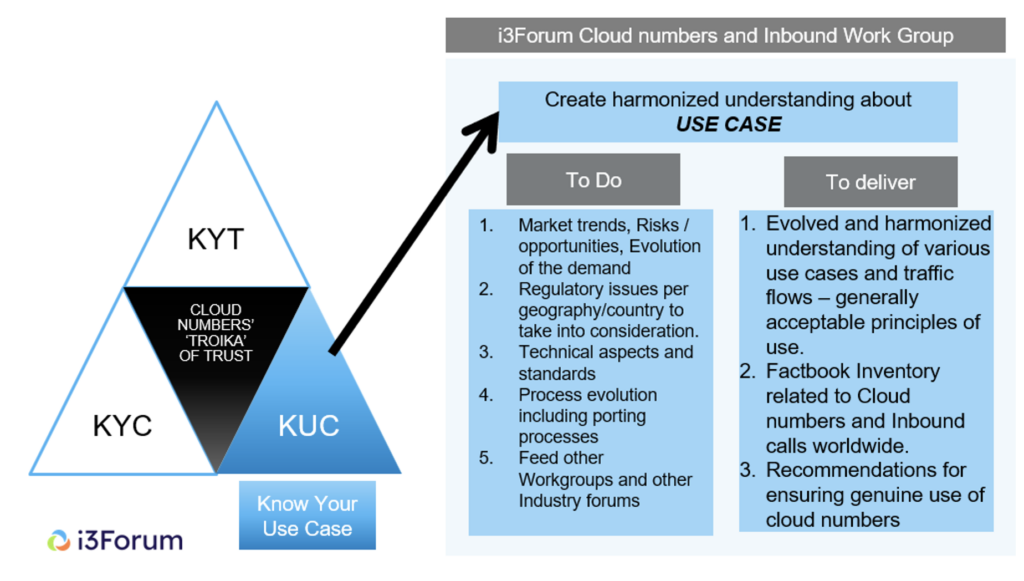
This is where the troika of trust becomes essential anchored in Know Your Customer (KYC), Know Your Traffic (KYT), and Know Your Use Case (KUC).
KYC establishes accountability by ensuring that service providers have a clear understanding of who is consuming cloud number services. In a global, multi-tenant environment, robust customer identification is foundational to preventing misuse.
KYT brings operational visibility. Understanding traffic patterns, monitoring for anomalies, and ensuring alignment with declared intent are critical to maintaining network integrity and detecting potential abuse.
KUC provides the regulatory and contextual anchor. Clearly defining and validating use cases-aligned with national regulations-reduces ambiguity and ensures that services are deployed in a manner consistent with local requirements.
Together, these pillars transform trust from a concept into a set of enforceable practices.
For the industry, this is no longer a question of adoption-it is a test of credibility. As cloud numbers scale, stakeholders across the value chain will be expected to demonstrate capability and control across the value chain. KYC, KYT, and KUC are not just the best practices to aspire to; they are operational baselines to be enforced.
The role of forums like i3Forum is therefore pivotal- to help define the problem, and drive convergence on solutions. Because in the next phase of growth, trust will not be assumed. It will be verified.
Credits:
Nishant Arya, Vice President
Tata Communications